
The Chartwell Capital Markets group is pleased to present the Q3 2026 edition of its Debt Capital Markets Trends newsletter. This publication includes a comprehensive overview of recent debt market volume, trends, pricing, and current areas of interest across both the bank and private credit markets, including redemption requests at non-traded private credit funds. Also featured is an in-depth look at the junior capital markets covering subordinated debt structures and mezzanine financing. A final note, this publication provides an overview of the private placement market, highlighting current volume and pricing trends.
SNAPSHOT
Current Debt Capital Markets
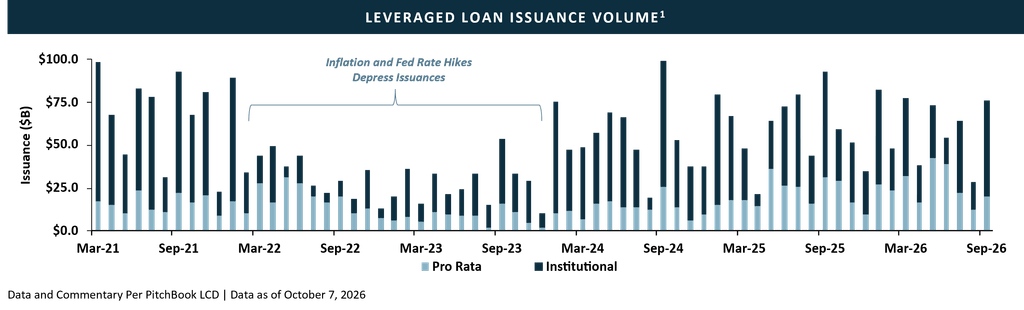
Even with continued headwinds, including a Fed rate hike, renewed Iran-US hostilities that pushed oil prices higher, and AI disruption threats, leveraged loan markets remain active.
- As previously shared, the consensus in the U.S. leveraged loan market for 2026 held that repricing issuances would fade and M&A would gradually take over as the primary volume driver. That balance has improved: year-to-date, institutional repricing amendments are down 42% and refinancings down 20%, while institutional M&A-related volume is up 16%. Q3 issuance (excluding repricing amendments) totaled ~$164B, down 2% quarter-over-quarter and 24% year-over-year
- Sponsor activity rebounded from a Q2 low: LBO loan volume rose 38% quarter-over-quarter to $23.4B, and September’s $30.6B of institutional LBO/M&A volume was the highest monthly total since January 2022, led by a dozen $1B+ term loans, the most in five years
- Non-LBO M&A softened, falling 22% quarter-over-quarter to $31.8B against a Q2 lifted by the $13B Warner Bros. Discovery loan, leaving total M&A-related volume of $55.3B down 4% quarter-over-quarter and up 3% year-over-year
- Credit availability remains strong for borrowers, but lenders are growing more cautious, with market participants expecting tighter credit terms and higher sponsor equity contributions amid macro uncertainty
- Pricing looks borrower-friendly for higher-quality credits competing for new money, but lower-rated borrowers refinancing ahead of the 2028 maturity wall are paying up
Contact any of our Capital Markets experts to discuss financial advisory opportunities or potential capital structure alternatives